Why Tree Removal Metairie Requires Specialized Tools and Training

Anyone who has watched a tree come down cleanly might assume the work is mostly about strength, nerve, and a chainsaw. From the ground, it can look almost simple. A few cuts, a controlled fall, then a crew with a chipper and a truck. The reality is far less forgiving. Tree removal is one of those trades where a small miscalculation can turn expensive in a heartbeat, and in the worst cases, catastrophic.
That is especially true in a place like Metairie, where mature trees often stand close to homes, fences, driveways, power lines, patios, drainage features, and narrow access points. The local environment adds its own complications. Saturated soil after heavy rain, root systems affected by compacted suburban lots, storm damage, leaning trunks, and hidden internal decay all change the way a tree behaves under load. That is why tree removal Metairie property owners rely on is not a general handyman task. It requires equipment chosen for specific conditions and training built on far more than basic saw operation.
The trees themselves deserve respect. So do the structures around them. Once you understand what actually happens during a removal, it becomes clear why professionals invest so heavily in rigging systems, climbing gear, aerial lifts, saw maintenance, crew communication, and hazard assessment.
The difference between cutting wood and removing a tree
A standing tree is not just a piece of wood waiting to be cut. It is a loaded structure. The trunk carries weight. The crown can be unbalanced. Limbs may be under tension or compression. A lean that looks slight from one angle can shift the center of gravity enough to change the entire removal plan.
That is the first place inexperience shows. Many people understand how to cut firewood. Far fewer understand how a vertical stem reacts once fibers begin to fail. A branch that appears dead may still hold just enough to swing unexpectedly when released. A cavity hidden from the ground can turn a planned notch and back cut into a dangerous guess. Even a healthy tree can barber chair, twist, or kick back material when cuts are placed poorly.
In residential neighborhoods, there is almost never room for error. The old image of dropping a full tree into an open field simply does not match the job site most crews see in Metairie. More often, the work is sectional. That means dismantling the tree piece by piece, controlling each cut section with ropes, lowering devices, friction management, and precise communication between the climber or lift operator and the ground crew.
That kind of work is technical. It is not only about bringing the tree down. It is about deciding how every piece will move before the saw touches it.
Why Metairie properties make removals more complex
Urban and suburban tree work has its own pressure points, and Metairie has plenty of them. Lots can be tight. Backyards may be fully enclosed. Many older trees were planted decades ago, long before additions, sheds, outdoor kitchens, or expanded driveways narrowed the work zone. A crew may need to remove a large oak or pine without touching a roofline only feet away.
The climate matters too. South Louisiana storms do not just break branches, they expose structural weaknesses that may not show up in calm weather. A tree can survive years of stress, then develop a split union, compromised root plate, or unstable top after one intense wind event. Waterlogged soil can reduce root holding strength, which means a tree that seemed stable last month may now require a more cautious approach.
Then there is access. Sometimes the right tool is not the biggest saw or the strongest winch, but the machine that can fit through a side gate without destroying landscaping. Crews often have to think in reverse order: not just how to remove the tree, but how to get personnel, rigging, and debris out efficiently and safely.
Those constraints are exactly why specialized tools matter. They do not make the work easy. They make difficult work possible.
The equipment professionals rely on, and why each tool exists
People tend to focus on chainsaws because they are visible and familiar. In practice, a chainsaw is only one part of a much larger system. Professional tree removal depends on a set of tools designed to manage height, weight, force, and unpredictability.
Climbing systems are a prime example. A trained climber does not simply strap on spikes and ascend. The setup may include climbing lines rated for life support, friction hitches or mechanical devices, saddles, lanyards, redirects, ascenders, helmets, eye protection, hearing protection, and saw attachment systems. Every component serves a purpose. If one piece is chosen poorly, the entire climb becomes riskier.
Rigging gear is equally important. Lowering a heavy limb over a house is not a matter of tying a rope and hoping the crew catches it. Professional systems may use high strength rigging lines, blocks, pulleys, slings, friction devices, and port-a-wrap style lowering tools to absorb force and control descent. The difference between free-falling a section and lowering it under tension can be the difference between preserving a fence and replacing it.
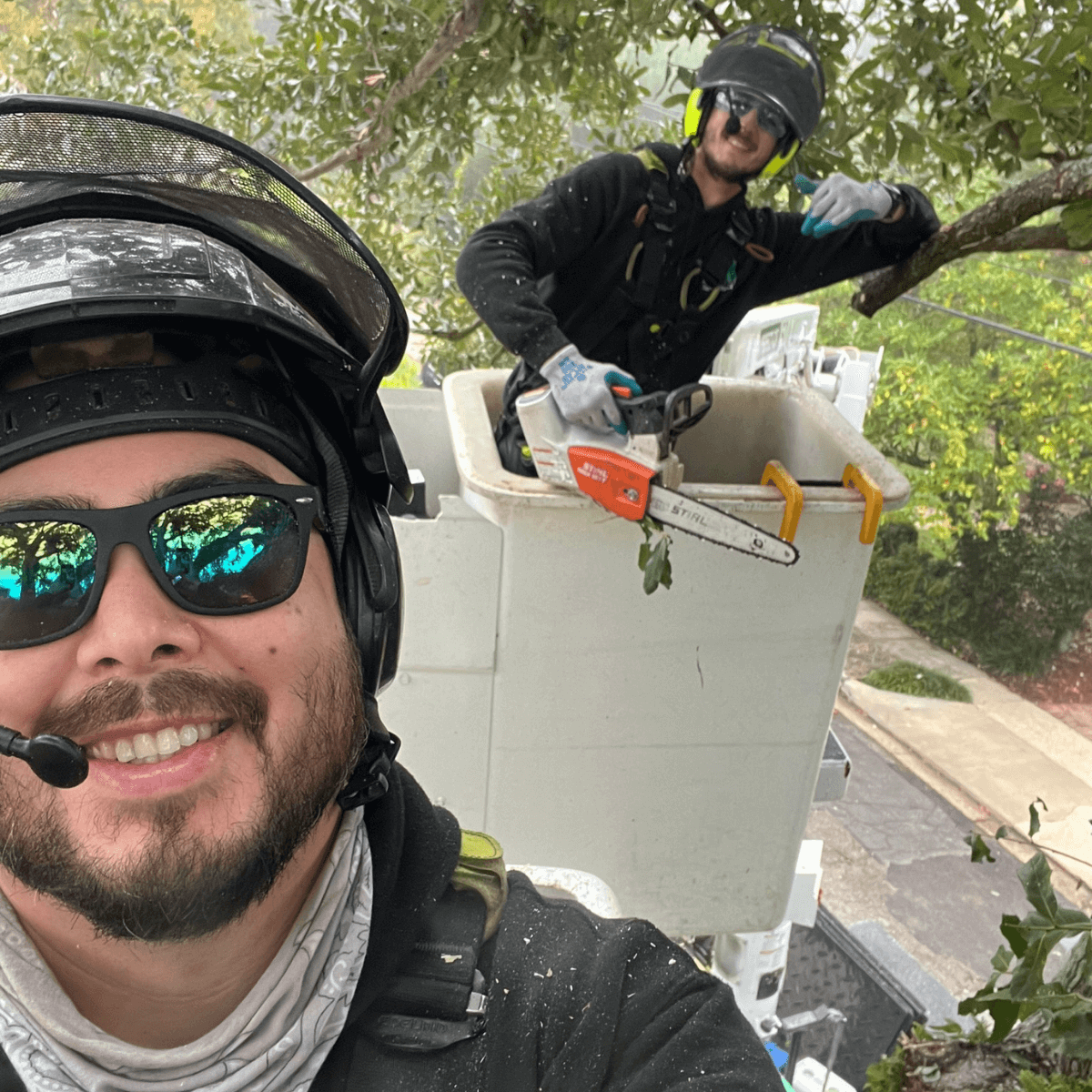
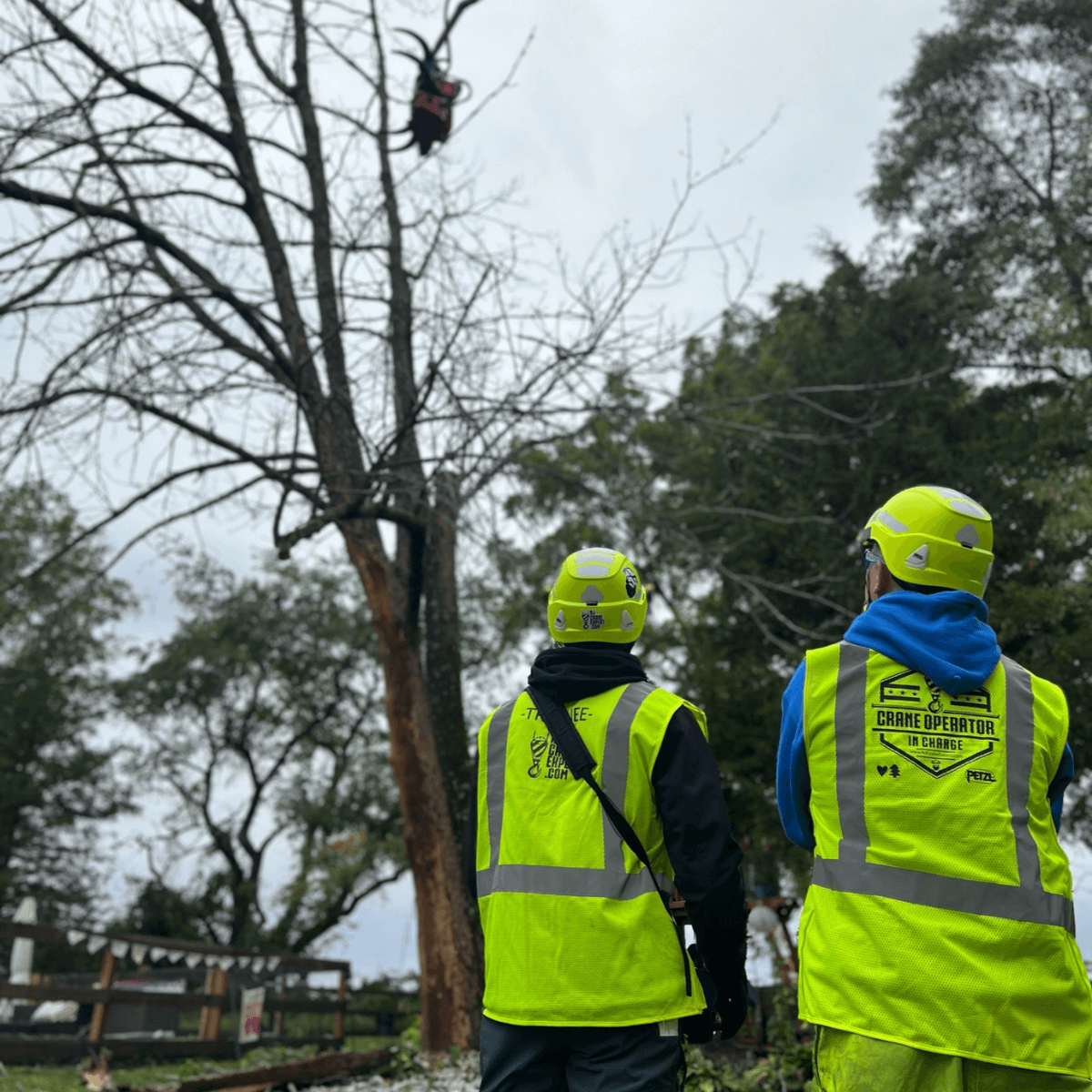
Aerial lifts and bucket trucks come into play when climbing would be slower, less stable, or simply inappropriate for the tree’s condition. If a stem is cracked, decayed, or storm-damaged, sending a climber into it may not be the smartest option. A lift allows access while reducing exposure. Cranes may be used when trees are too large, too compromised, or too boxed in by structures to dismantle conventionally. That is highly planned work. Every pick has to be estimated, balanced, cut correctly, and coordinated with the operator.
Ground equipment often gets less attention, but it matters just as much. Chippers, mini skid steers, stump grinders, log tongs, winches, and debris trucks are not luxury add-ons. They reduce manual strain, speed up cleanup, and help a crew keep the site controlled rather than chaotic. A job that drags because the crew lacks the right equipment usually becomes more hazardous as fatigue builds.
Here are some of the tools that separate professional removals from improvised ones:
- climbing and rigging systems rated for arborist work
- aerial lifts or bucket trucks for compromised or hard-to-reach trees
- specialized chainsaws with bars and power matched to the cut
- lowering devices, pulleys, and slings to control heavy wood
- chippers, stump grinders, and compact loaders for safe cleanup and site access
What matters is not just owning these tools. It is knowing when to use them, when not to use them, and how they interact under real load.
Training is what turns equipment into safe practice
A chainsaw in untrained hands is dangerous. A full set of arborist rigging gear in untrained hands can be worse, because it creates false confidence. Professional tree work depends on judgment developed through training and repetition.
Good crews are constantly reading wood fiber, lean, tension, swing path, anchor strength, saw position, footing, weather, and crew spacing. They know that a healthy-looking branch union can still be weak. They know species differences matter. They know how humidity, heat, and rain affect stamina and traction. They know when to stop and revise a plan rather than pushing through because the clock is ticking.
Training also covers cut sequencing. Where exactly should the notch go? How deep? What hinge dimensions fit this stem and this objective? Is the piece being balanced for a clean lift, or intentionally biased to swing clear of a roof? Should the top be pieced out in smaller sections because of decay, or can it be blocked down more efficiently? These are not instinctive decisions. They come from instruction, field experience, and often from learning what can go wrong.
One of the clearest signs of a well-trained crew is communication. On a safe job site, commands are short, specific, and consistent. The climber and ground crew know who is in charge of each phase. The person on the lowering device is not guessing when the cut is complete. The person feeding the chipper is not drifting into the drop zone. That discipline is built, not assumed.
Hidden hazards that homeowners rarely see
From the driveway, a tree may look straightforward. Up close, it often tells a different story. Hollow sections, fungal decay, included bark at a union, old lightning scars, root damage from past excavation, girdling roots, dead tops, hanging limbs, and insect damage can all change a removal plan.
One common issue is internal decay that leaves the outer shell of the trunk looking sound. A sawyer may begin a standard cut and realize the holding wood is not what it should be. Another is stored tension in storm-damaged limbs. A branch pinned against another branch can release energy violently when cut. That is why experienced crews spend time inspecting before they climb or set a saw.
Power lines add another layer. Trees near utility lines are not a place for experimentation. Depending on line type, location, and ownership, the right response may involve utility coordination rather than immediate cutting. Even when direct contact is not present, conductive tools, swinging limbs, and climbing lines create risk corridors that demand strict planning.
Wildlife can complicate jobs as well. Nests, bees, wasps, squirrels, and other animals are not just inconveniences. They can force a climber into a hurried movement, and hurried movements are where accidents start.
A trained arborist crew learns to see these conditions before they become emergencies. That visual literacy is one of the least visible but most valuable parts of the profession.
Why storm-damaged trees require even more skill
Storm work tends to create a false sense of urgency. A homeowner sees a broken top over a roof or a tree leaning after high winds and wants immediate action. Sometimes immediate tree removal metairie A Perfect Cut Tree Service action is necessary. Just as often, the first priority is stabilization, site control, and damage assessment.
Storm-damaged trees do not behave like intact trees. Fibers may already be split. Sections can be hung up and loaded in ways that are difficult to predict from the ground. The root plate may be partially lifted. A trunk can look standing while actually being held up by adjacent branches or nearby structures.
This is one area where experience is hard to fake. A removal that would be routine in a healthy tree becomes delicate when every cut changes the load path. Crews may need tag lines, secondary tie-ins, temporary supports, or an entirely different access method than they would use on a normal day. They may also choose to remove less at first, simply to eliminate immediate hazards without triggering larger movement.
That caution is not hesitation. It is competence.
The real cost of getting it wrong
People often compare tree removal estimates without understanding what they are actually buying. The lowest price can reflect smaller insurance coverage, weaker equipment, less training, or a plan built on speed rather than control. Sometimes it reflects an operator who intends to “just drop it” and hope the available space is enough.
When a tree removal goes badly, the bill usually multiplies fast. Roof damage, crushed fencing, broken pavement, damaged sewer lines, torn irrigation, injured workers, and emergency utility issues can dwarf the original estimate. Even less dramatic mistakes carry costs. Rutted lawns from inappropriate equipment, torn-up beds, incomplete cleanup, and poorly cut stumps leave a homeowner paying twice.
There is also the issue of personal liability. If an uninsured or underinsured operator gets hurt on a property, the situation can become messy very quickly. Reputable professionals price jobs to cover trained labor, maintained equipment, insurance, disposal costs, and the time needed to remove wood safely. That is not overhead padding. It is what responsible work looks like.
A good removal plan is built before the first cut
One of the best indicators of professionalism is what happens before the saw starts. A solid crew studies the tree, the target zone, access points, lean, defects, and cleanup route. They do not improvise the entire job from the canopy.
A typical plan may account for the order of limb removal, rigging anchor points, drop zone boundaries, equipment placement, chipper position, rope path, and wood handling. If weather shifts, they reassess. If the tree opens up differently than expected, they adjust. That planning stage is where specialized training pays for itself.
It is also where local familiarity helps. Teams that regularly handle tree removal Metairie jobs understand common lot layouts, the effect of soggy ground on machine access, and the way storm season changes scheduling and urgency. They know that preserving drainage flow, avoiding underground utilities, and managing narrow suburban workspaces are not side issues. They are central to the job.
Stump removal is its own discipline
Many property owners think of stump grinding as a cleanup extra, but it also illustrates why specialized equipment matters. A stump left in place can interfere with replanting, mowing, pest control, and future hardscaping. Grinding it out seems simple until you consider buried roots, utilities, nearby foundations, and grade restoration.
Professional stump grinders are designed to cut below grade efficiently while containing debris. The operator still has to assess access, guard windows and vehicles from flying chips, avoid utility conflicts, and decide how far the root flare should be addressed based on future use of the area. A decorative bed has different requirements than a lawn replacement or a site being prepared for construction.
That judgment does not come from renting a machine for the weekend. It comes from doing the work repeatedly and understanding what the next phase of the property needs.
What homeowners should listen for when hiring a crew
Most people are not expected to know arborist terminology, but they can still spot signs of competence. The difference often shows up in the questions the company asks. A serious contractor wants to know about access, structures, utility proximity, tree condition, storm history, and the desired end result. They explain whether the tree will be climbed, lifted, rigged, or craned. They talk about cleanup, stump options, and protection for surrounding areas.
A less careful operator tends to oversimplify. If the entire consultation is “we’ll cut it down and haul it off,” that is not reassuring. Tree removal is rarely that generic, especially around established homes.
A few practical checks help separate true professionals from opportunists:
- ask whether they are insured for tree work, not just general labor
- ask how they plan to access and remove the tree on your specific lot
- ask whether they will protect fences, driveways, and nearby structures
- ask what happens if the tree has storm damage or hidden decay once work begins
- ask whether stump grinding and debris disposal are included or separate
These questions are not about challenging the crew. They are about confirming that a real plan exists.
Why training never really stops in this field
Tree work changes constantly because no two removals are identical. A crew may handle ten oaks in a month and still face a new problem on the eleventh. One trunk has a seam that opens under load. One backyard has impossible access after rain. One lean that looked manageable from the street turns out to be tied into a neighboring canopy in a way that complicates every cut.
That is why strong companies keep training. They review incidents, update rigging methods, maintain equipment meticulously, and learn from unusual removals. The best professionals stay humble around trees because experience teaches the same lesson over and over: nature does not care how many routine jobs you handled last week.
For homeowners, that ongoing discipline matters more than branding or sales language. The safest crews are usually the ones who respect the unpredictability of the work enough to keep sharpening their methods.
The reason specialized tools and training belong together
It is tempting to think of equipment and skill as separate advantages, but in tree removal they are inseparable. The best rigging system in the world is useless if the crew cannot calculate load and swing. A bucket truck does not eliminate hazard if the operator cannot read a compromised stem. A powerful chainsaw only speeds up mistakes when the cut is wrong.
What makes professional tree removal work is the combination. The tools create options. Training tells the crew which option fits the tree, the site, the weather, and the risk level. That is the reason property owners searching for tree removal Metairie services should look beyond price alone. They are not just hiring someone to cut wood. They are hiring a team to manage height, force, uncertainty, and property protection under conditions that can shift minute by minute.
When that job is done well, it looks calm. The tree comes apart in measured sections. The lawn stays mostly intact. The roof remains untouched. The cleanup moves smoothly. That calm is earned. It rests on specialized equipment, practiced judgment, and the kind of training that only shows its value when there is a lot that could have gone wrong, but did not.
A Perfect Cut Tree Service
4725 Shores Dr, Metairie, LA 70006
+1 504-732-0779
FAQ About tree removal metairie
What is the average cost of tree removal in my area?
There is no single price that fits every tree. Size, condition, access, nearby structures, equipment, debris hauling and stump work affect the estimate. Request a written, site-specific quote that identifies what is included.
Who will remove trees for free?
Free removal is not generally available for ordinary private-property tree work. Utilities or public agencies may handle trees within their responsibilities. Confirm eligibility directly and do not assume that an offer or assistance program covers your tree.
Can I just cut down a tree in my yard?
Check ownership, location and local requirements first. Jefferson Parish requires a permit for removal of qualifying vegetation in the public right-of-way, and additional protections may apply in designated areas. Ask the parish about your property and have a qualified tree professional assess the work.
Ends · SERGIOQBZE104